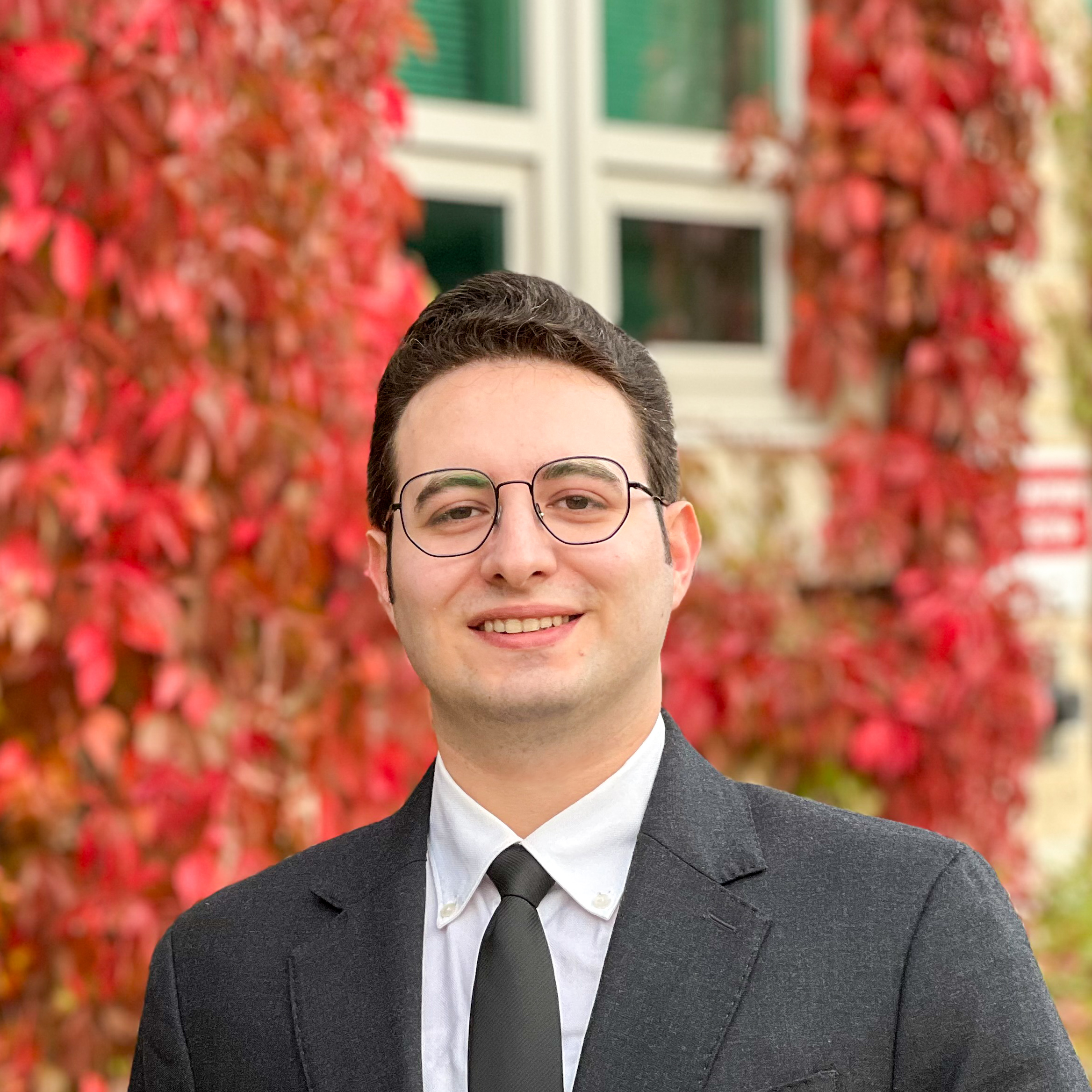
Ali Tafakkor
About Me
I am a Ph.D. student at Western University, Ontario, Canada working with Dr. Ingrid Johnsrude (CoNCH Lab) and Dr. Ali Khan (Khan Lab). I also serve as support staff for the BrainsCAN Computational RIC. I hold an M.Sc. in Neuroscience and a B.Sc. in Electrical Engineering.
Research Interests
- Cognitive Neuroscience: Examining neural mechanisms behind cognitive processes, with a focus on naturalistic stimuli related to hearing and speech.
- Computational Neuroscience: Utilizing computational methods to model auditory and speech processing in the brain.
- Neuroimaging: Employing neuroimaging techniques to investigate the neural basis of auditory and speech functions, with clinical applications in mind.
Featured
Sept. 18th, ID: 21 |
Probing Connectivity among Auditory Cortex Subdivisions and the Multiple Demand Network During Listening to Clear and Degraded Speech |
Authors: Ali Tafakkor, Madison Tutton, Aysha Motala, Björn Herrmann, Ingrid Johnsrude 
Imagine sitting in a bustling café, trying to follow a friend’s story while dozens of other voices overlap in the background. Your ears alone aren’t enough — your brain calls in extra support, engaging problem-solving and attention networks to keep track of the conversation.
In our study, we examined how the brain reconfigures its networks when listening conditions shift from clear to noisy. Using fMRI during naturalistic story listening with varying levels of background chatter, we measured functional connectivity (FC) between auditory cortex subdivisions and the Multiple Demand (MD) network.
We found that:
- Connectivity within MD regions increases as speech becomes harder to understand.
- Connectivity within auditory cortex decreases, especially in primary auditory areas, under noisy conditions.
- The right insula emerges as a key hub, bridging auditory and MD networks and adapting strongly to degraded speech.
These results highlight how the brain flexibly balances auditory and cognitive systems to support speech comprehension in challenging environments — a dynamic that may inform interventions for hearing loss, aging, and other listening difficulties.
News
- [July 2025] Honored to receive the Western Institute for Neuroscience (WIN) Open Science Peer Support Award for contributions to open and collaborative research at Western University (WIN Open Science Awards).
- [May 2025] Received an Erasmus+ grant to undertake a research exchange between the Western Institute for Neuroscience (WIN) and the Donders Institute (Radboud University, Nijmegen), supporting international collaboration and training in neuroscience.
- [March 2025] Proud to have been the head organizer of Brainhack Western 2025, fostering collaboration and innovation in neuroscience and open science.
- [January 2025] Started my Ph.D. in the Neuroscience program at Western University, Ontario, Canada in the CoNCH Lab and Khan Lab.
- [October 2024] Started my role as a computaional server support staff at BrainsCAN Computational RIC.
- [June 2024] Presented a poster on “Feasibility of Localizing Epileptogenic Tissue with Naturalistic Stimulation in fMRI” at the Organization of Human Brain Mapping 2024 annual meeting.
- [April 2024] Presented a poster on “Dynamics of the Multiple Demand Network Connectivity Under Varied Speech to Noise Ratios” at the Cognititve Neuroscience Society 2024 annual meeting.
- [September 2023] Began my role as a Research Technician at the CoNCH lab.
- [August 2023] Graduated with a Master’s in Neuroscience from Western University.
- [August 2023] Published my Master’s thesis in Western University’s Electronic Theses and Dissertations. View Thesis.
- [August 2023] Successfully defended my Master’s thesis.
- [July 2023] Presented a poster on “Temporal Dynamics of Neural Sound Categorization” at the Organization of Human Brain Mapping 2023 annual meeting.